Two numbers explain most of a detector score. Neither is about authorship.
We took 19 texts with known ZeroGPT scores and computed the features detectors claim to use. Sentence-length variation correlated at −0.76. Vocabulary richness correlated at 0.01. Then we found five rewrites with almost identical variation and scores from 0 to 97.
8 min read · Published October 2026 · Method and data at the bottom. This is the follow-up to our control test, where four of six human-written passages were flagged as AI.
The question people actually ask
"Which detector should I trust?" is the wrong question. Two detectors reading the same paragraph routinely disagree, and the same detector changes its mind after a model update. That looks like a bug until you understand what the number is made of.
So we stopped arguing about vendor claims and measured it. Every text we had a ZeroGPT score for — nineteen of them, human and machine — got the same treatment: sentence-length statistics, stock-phrase counts, vocabulary variety, length. Then we correlated each feature with the score.
What detectors say they measure
- Burstiness. Variation in sentence length. Language models drift toward a comfortable middle; people don't. High variation is supposed to read human.
- Perplexity. How predictable each word is given the previous one. Fluent, obvious word choices lower it.
- Stock phrasing. "Delve", "furthermore", "in today's fast-paced world". A real but shallow signal.
Two of those three are computable on any text without an API key. That is what makes this test possible.
The correlations
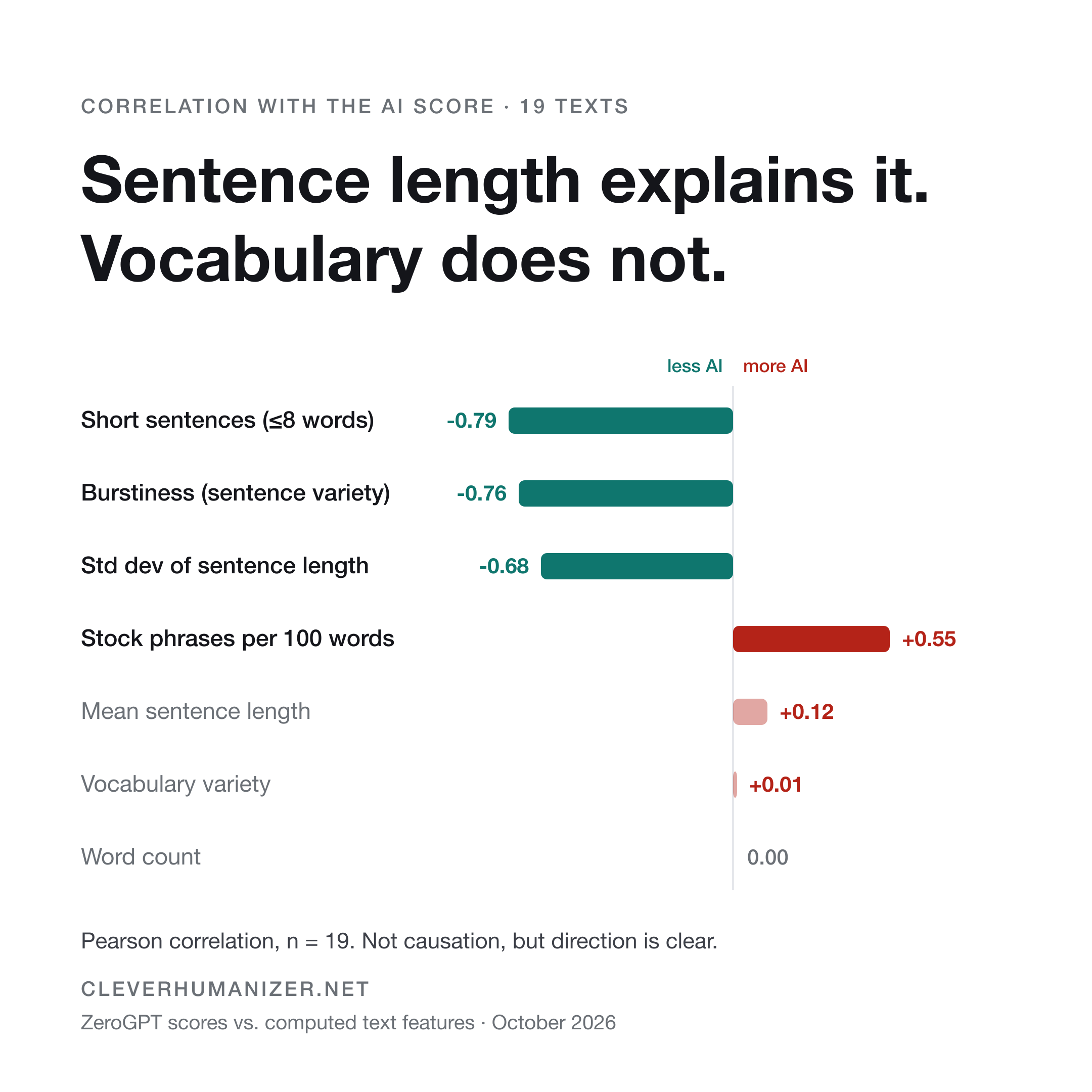
| Feature | Correlation with ZeroGPT score | Reading |
|---|---|---|
| Short-sentence ratio (≤8 words) | −0.79 | Strongest single predictor |
| Burstiness (sd ÷ mean sentence length) | −0.76 | Strong, as advertised |
| Standard deviation of sentence length | −0.68 | Same signal, different scale |
| Stock phrases per 100 words | +0.55 | Real, weaker than expected |
| Mean sentence length | +0.12 | Almost nothing |
| Vocabulary variety (type-token ratio) | +0.01 | Nothing at all |
| Word count | −0.00 | Nothing at all |
n = 19, one detector, English, Pearson. Small sample — treat these as directional, not definitive.
Two things this settles
Burstiness is real. The detector is not a black box making things up. It responds to sentence-length variation the way it says it does, and the effect is large.
Vocabulary advice is useless. A generation of writing guides says "vary your word choice to sound human". In our data, vocabulary variety correlated at 0.01 — statistically indistinguishable from noise. Swapping synonyms does nothing, which matches what we found when we asked a model to "polish the prose": the score did not move at all.
And one thing it breaks
If burstiness were the whole story, texts with similar variation would get similar scores. They don't. Here are the five rewrites our own tool produced:
| Rewrite | Burstiness | Short sentences | ZeroGPT |
|---|---|---|---|
| LinkedIn post | 0.71 | 50% | 0% |
| Blog paragraph | 0.62 | 43% | 28.6% |
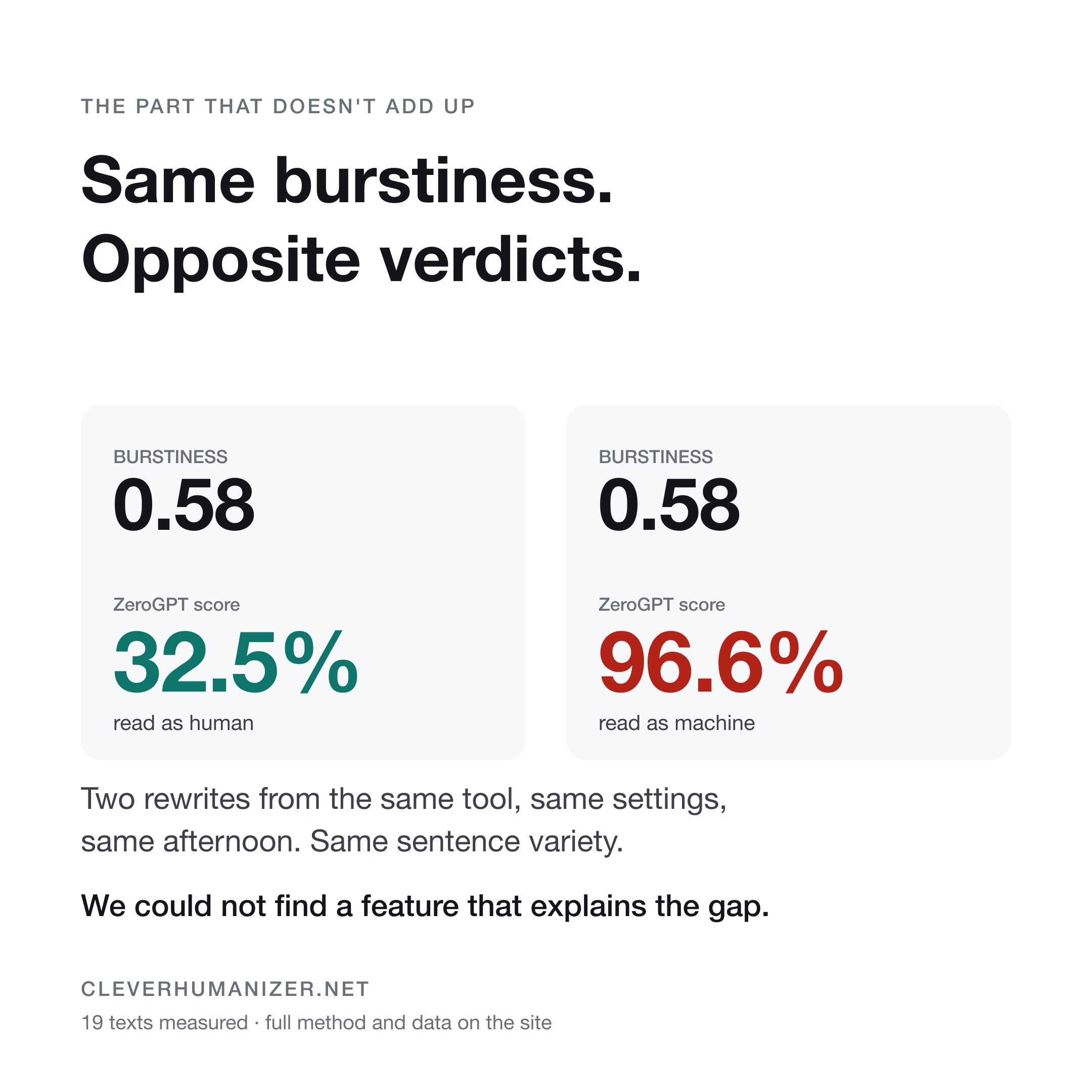
| Academic essay | 0.58 | 29% | 32.5% |
| Student essay | 0.58 | 17% | 96.6% |
| Partnership email | 0.51 | 38% | 0% |
Look at the middle pair. Burstiness 0.58 both times. One scored 32.5, the other 96.6. Whatever separated them, it is not sentence-length variation — and we could not find it in any feature we measured.
The original texts behave the same way. The two highest-variation samples in the whole set were both written by a person: a work email at 0.72 scored 0%, a 341-word memoir at 0.62 scored 69.8%. Same feature, opposite verdicts.
So why do two detectors disagree?
Three reasons, in order of how much they matter:
- They weight features differently. One leans on burstiness, another on perplexity, a third on n-gram overlap with known model output. Same text, different arithmetic.
- They set thresholds differently. A raw score of 0.6 can be "likely AI" on one site and "mixed" on another. The threshold is a product decision, not a measurement.
- They were trained on different data. A model trained before your favourite writing assistant existed will misjudge its output in predictable ways.
None of those three is a disagreement about who wrote the text. They are disagreements about how to score a style, which is why neither answer can settle the question.
What actually moves a score
Based on our data, in order of effect size:
- Write short sentences. The share of sentences at eight words or fewer was the strongest predictor we found. Three, four in a row is fine — people do that.
- Break the rhythm. Long, short, long, very short. Not medium, medium, medium.
- Cut the stock phrases. Real effect (+0.55), smaller than most people assume.
- Do not bother swapping synonyms. Effect: none measurable.
- Do not pad the word count. Effect: none measurable.
What this does not tell you
- Nothing about authorship. A style score cannot establish who typed the words. Our control test remains the clearest demonstration: four of six human-written passages came back at 50% or above.
- Nothing about other detectors. We tested one. GPTZero's API needs a paid key and Turnitin needs an institutional account, so we have no numbers for them and will not pretend otherwise.
- Very little about long text. Our longest sample is 341 words. Beyond a few thousand words, section-level scores start to diverge and the aggregate means less than it appears to.
Frequently asked
What is burstiness in plain terms?
How much sentence length varies in a passage. Three long sentences in a row: low burstiness. A 40-word sentence followed by a 4-word one: high burstiness. Models tend to produce the first pattern, so detectors use it as a signal.
Is high burstiness enough to pass?
No. In our data one rewrite with a burstiness of 0.58 still scored 96.6, while another at 0.51 scored zero. Burstiness moves the number; it does not determine it.
Why do two detectors give different answers?
They weight the same style features differently and set different thresholds. Neither one is measuring authorship, so neither one can overrule the other. Two opinions about style are still opinions.
Does vocabulary variety matter?
In our sample, no. The correlation between type-token ratio and the score was 0.01 — effectively nothing, despite variety being a popular piece of advice.
Data: metrics-vs-score-20261019.json — 19 texts, every feature, every score, plus the script that produces it. Corrections to [email protected].
Apply the two features that work
3,000 words per run, no signup. We publish the failures too.