We tested ZeroGPT with human writing. It failed.
Six passages written by a person, no AI involved. Four of them came back at 50% or higher, and two came back at 100%. Here is the data, the method, and what it means if you have ever panicked at a detector score.
9 min read · Published October 2026 · Raw data: every sample and score is in the JSON file linked at the bottom.
Why we ran this
We built a rewriter, so we had an obvious motive to trust detector scores: they are the easiest way to show the tool "working". Before publishing any of those numbers, we did the thing vendors usually skip — we pointed the detector at text with a known origin.
If a detector is sound, human-written prose should come back near zero. It did not.
The method
- Nine samples. Six written by a person with no AI assistance. Three generated by a language model in the familiar register: "in today's fast-paced world", "furthermore", "ultimately".
- One detector. ZeroGPT's public endpoint (
api.zerogpt.com/api/detect/detectText), which returnsfakePercentage— the share of text it believes was machine-generated. - Each sample scored twice. Same text, minutes apart, to separate noise from bias.
- No editing. The human samples are reproduced exactly as written, including the digressions and the sentence fragments.
The results
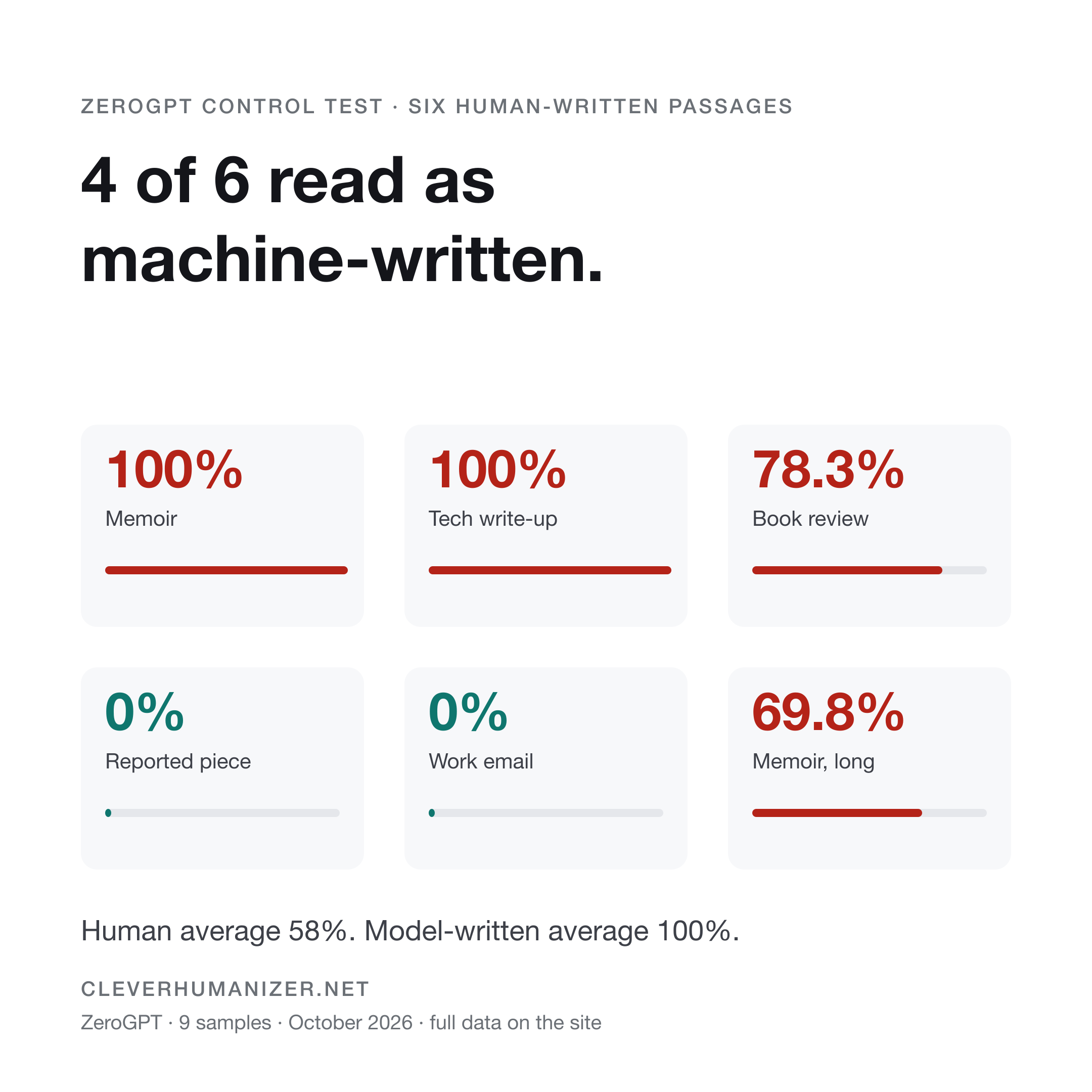
| Sample | Words | Written by | ZeroGPT |
|---|---|---|---|
| Memoir, first person | 88 | Human | 100% |
| Technical explainer (SQLite) | 78 | Human | 100% |
| Book review | 69 | Human | 78.3% |
| Reported piece | 75 | Human | 0% |
| Work email | 65 | Human | 0% |
| Memoir, long form | 341 | Human | 69.8% |
| Generic business copy | 41 | Model | 100% |
| Product description | 40 | Model | 100% |
| Long business article | 224 | Model | 100% |
Human average: 58 out of 100. Model average: 100. Four of six human samples scored 50 or above.
The one that should bother you
This is the opening of the memoir sample, written by a person about a summer job:
My grandmother kept her recipes on index cards, the kind with a blue rule across the top. She wrote in pencil, always pencil, because she said ink made her feel committed to a version of a dish she might want to change next Sunday.
ZeroGPT returned 100% AI. Twice.
Read it out loud. There is a specific detail — the blue rule, the pencil, the reason for the pencil — that no model would invent unprompted, and a rhythm that is deliberately uneven. The detector saw none of that. It saw polished prose with no typos and made the only inference it knows how to make.
It is not random. That is worse.
We ran every sample twice. The scores came back identical: 100 and 100, 0 and 0, 69.8 and 69.8. So this is not noise you can wait out. It is a stable, systematic bias — the detector applies the same wrong rule every time.
That distinction matters. Random error means "run it again". Systematic bias means "this measurement has a floor and a ceiling that have nothing to do with who wrote the text".
What it is actually measuring
Detectors do not look for a watermark. They score text against patterns models tend to produce:
- Burstiness — variation in sentence length. Models drift toward the middle. So do careful writers.
- Perplexity — how predictable each word is given the last. Fluency lowers it. Editors reward fluency.
- Stock phrasing — "delve", "furthermore", "in today's fast-paced world". A real signal, and a weak one on its own.
Every one of those is a style property, not an authorship property. Which means the better you write — cleanly, evenly, without typos — the more you look like the thing it is trained to catch.
Does length save it?
Partly, and not enough. The 341-word memoir scored 69.8%. Our shortest human samples were the most erratic: two came back 0%, two came back 100%. Under a hundred words, the same person writing on the same afternoon can land anywhere on the scale.
If you just got a 100% score
- Run your own control. Paste something you wrote years ago, before any AI existed. If that also scores high, the number is not about you.
- Check the length. Under 200 words, treat the score as decoration.
- Ask what decision the score is being used for. "This reads like AI" is a style opinion. "This person cheated" is an accusation that a style opinion cannot support.
- Keep your drafts. Version history in a document beats any detector, in every appeal process.
Run the test yourself in five minutes
- Pick two texts you are certain about: one you wrote, one a model wrote.
- Cut both to roughly the same length, ideally 250+ words.
- Run both through any detector twice.
- Write down four numbers.
- If your human text scores above 50, the detector has told you more about itself than about your writing.
What this changes on our site
We stopped saying "0% AI" anywhere. Every score we publish now sits next to the human baseline, and we publish our failures — including the academic mode that barely moves and one student essay that went from 100% to 96.6%.
If you are looking for a tool that guarantees a pass on Turnitin: nobody has one, and the numbers above are why. If you want your draft to stop sounding templated, that is a real and achievable thing, and it is what our rewriter is actually for.
Next in this series: we computed the features detectors claim to use across all nineteen texts and correlated them with the score. Two numbers explain most of a detector score →
Frequently asked
Does this mean AI detectors don't work at all?
It means one detector, on short text, is not reliable evidence about authorship. It still ranked model-written samples higher than human ones on average. Use it as a style meter, not a verdict, and never as proof that a specific person cheated.
Why did the memoir score 100%?
We can only describe the pattern: even sentence length, polished transitions, no typos, no digressions. That is exactly what the detector is trained to look for — and it is also how careful human writers write. The detector cannot tell craft from generation.
What length should I test with?
Two hundred words minimum, and a sample you know the origin of. Below a hundred words the score moves between 0 and 100 for text written by the same person on the same afternoon.
Did you test other detectors?
Not yet. GPTZero's API needs a paid key and Turnitin needs an institutional account. We have no score for either and we are not going to invent one.
Is your own tool any better?
On the same metric, sometimes. Three of five samples dropped sharply; our academic mode barely moved and one student essay failed. The numbers are on the comparison page, including the failure.
Raw data: detector-calibration-20261019.json — nine samples with full text and scores, reproducible with the script in the same folder. Corrections welcome at [email protected].
Try the tool these numbers came from
3,000 words per run, no signup. We publish the failures too.